Cooking on the Aga: A User Friendly Guide
Intimidated by the Aga? Learn it's simple secrets, try our hearty chicken casserole, and discover why one Gablebach guest wanted one of their own.

There are certain things that make a country cottage feel like a proper country cottage.
Stone walls. Muddy boots by the door. A view that makes you stop halfway through making a cup of tea. and an Aga.
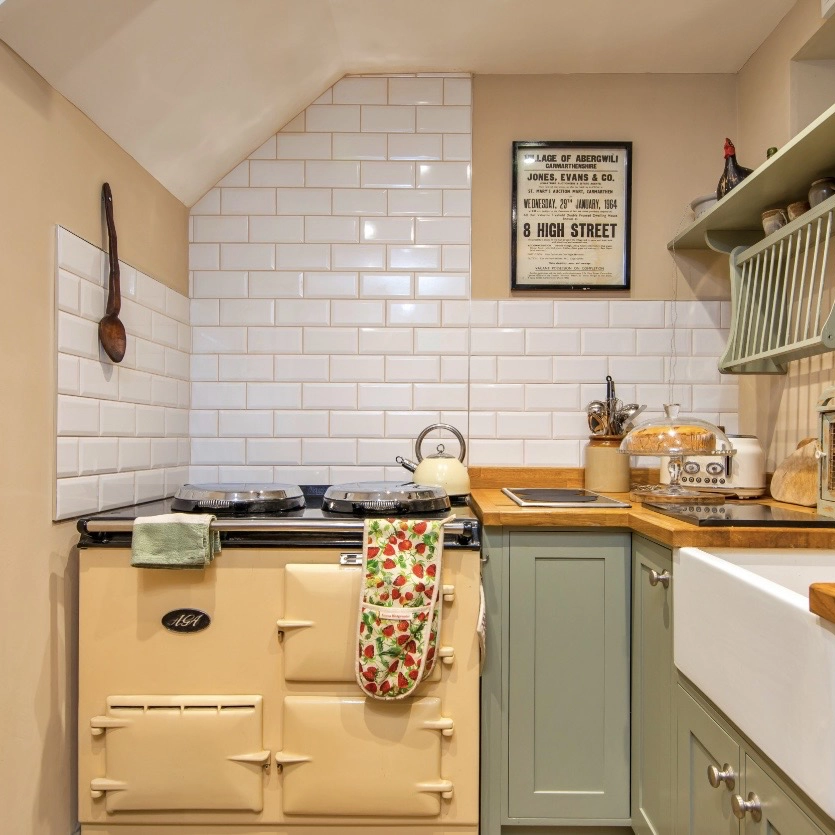
Our traditional two-oven Aga sits at the heart of the kitchen, quietly radiating warmth and looking reassuringly as though it knows exactly what it is doing.
For anyone who has never cooked on an Aga before, the first encounter can be slightly intimidating. There are two large hotplates, two ovens and the distinct impression that
generations of country cooks understood the simplicity of using an Aga.

There is a simplicity of cooking on the Aga, and once you’ve made friends with it, you may find yourself wondering why all cooking isn’t done this way.
Meet Your Aga
The two-oven Aga at Gablebach has four main cooking areas:
● A boiling plate
● A simmering plate
● A roasting oven
● A simmering oven
That’s essentially it.
Rather than constantly turning temperatures up and down, an Aga stores heat and gives you different areas for different types of cooking.
The trick isn’t changing the Aga to suit your food. It’s moving your food around the Aga.
Once you understand that, the whole thing suddenly makes sense.
Well, mostly.
The Boiling Plate: Where Things Happen Quickly. Lift one of the insulated lids and you’ll discover the hotter of the two hotplates: the boiling plate.
This is your powerhouse. Use it for anything that needs strong, direct heat — boiling
water, cooking pasta, frying, searing or getting a pan hot quickly. It’s wonderfully efficient.
Possibly a little too efficient if you become distracted by the view from the kitchen window.
So when using the boiling plate, stay nearby because the Aga does not believe in sending reminder notifications.
The Simmering Plate: The Gentler One
The second hotplate is the simmering plate. This gives you a gentler heat and is perfect for sauces, slow simmering, scrambled eggs and anything that doesn’t need the full enthusiasm of the boiling plate.
A useful rule of thumb is:
Boiling plate = hot and fast.
Simmering plate = slower and gentler.
You’ll very quickly get a feel for which one you need.
And if something is cooking rather more enthusiastically than
anticipated, simply move the pan across.
No complicated controls.
No frantic button pressing.
Just relocation.
The Roasting Oven: Hot, Hot, Hot
The upper oven is the roasting oven, and this is the hottest oven in the Aga.
This is where you roast meat, crisp potatoes, bake and cook anything requiring a good blast of heat. It’s also excellent for getting colour onto food.
One of the clever things about an Aga is that different parts of the oven have slightly different levels of heat, so where you position a dish can make a difference.
Generally, higher in the roasting oven means fiercer heat, while lower down is a little gentler.
Once you start experimenting, you’ll realise that cooking with an Aga is less about exact temperatures and more about instinct.
Which sounds terribly sophisticated.
The Simmering Oven: Low and Slow
Below the roasting oven is the simmering oven. This is the calm one.
It provides a much gentler heat and is perfect for slow-cooked dishes, casseroles and food that benefits from being left alone for several hours.
It’s particularly wonderful in autumn and winter.
Prepare something delicious in the morning, put it into the simmering oven, head out for a walk through the Carmarthenshire countryside and return several hours later to find dinner has quietly taken care of itself.
Especially when your “walk” somehow involved three hours in the pub!
Gablebach’s Walk-or-Pub Chicken Casserole
This is exactly the sort of thing the Aga does brilliantly: a proper, warming chicken casserole that can quietly cook while you head out for a hike.
Or just as happily while you head to the pub for “a quick one”.
Serves 4–6
You’ll need:
● 8 chicken thighs, preferably skin-on and bone-in
● 1–2 tbsp oil
● 2 onions, roughly chopped
● 2 carrots, sliced
● 2 celery sticks, sliced
● 2 cloves of garlic, crushed
● 200g mushrooms, halved
● 1 tbsp plain flour
● 500ml chicken stock
● A good splash of white wine or cider, if you have some
● 1 tbsp Dijon mustard
● A few sprigs of thyme
● 1 bay leaf
● Salt and black pepper
● A handful of chopped parsley to finish
First — brown the chicken. Don’t skip this bit.
Heat a large pan on the boiling plate with a little oil.
Season the chicken, then brown the thighs well on both sides,
working in batches if necessary. You want them properly
golden rather than vaguely introduced to the pan.
Remove the chicken and set aside.
Add the onions, carrots and celery to the same pan and cook
until they begin to soften. Add the mushrooms and garlic,
followed by the flour, and stir well.
Pour in the wine or cider, if using, and let it bubble briefly
before adding the stock, mustard, thyme and bay leaf.
Return the browned chicken to the pan and bring everything
back to a gentle simmer.
Transfer it all to a casserole dish, cover, and pop it into the simmering oven.
Then leave it alone for around 3–4 hours, until the chicken is
beautifully tender and the sauce rich and comforting.
There are a few simple rules that make Aga life considerably
easier.
Use the boiling plate for speed.
Boiling, frying, browning and searing belong here.
Use the simmering plate when you need gentler heat.
If a pan is getting too lively, move it across.
Use the roasting oven for high-temperature cooking.
Roasts, crisping, baking and browning are its territory.
Use the simmering oven for slow cooking.
Casseroles and long, gentle cooking are particularly happy
here.
And perhaps most importantly:
Keep the hotplate lids down when you’re not using them.
Those heavy insulated lids help the Aga retain its heat, so once you’ve finished with a hotplate, simply lower the lid again.
And If You and the Aga Simply Cannot Be Friends…
We accept that not every relationship is meant to be;
Gablebach also has an induction hob and microwave, so
nobody is required to master the Aga in order to eat.
And in the summer there’s a gas barbecue too.
So if all else fails, step away from the Aga.
Dinner can still happen.
Don’t Try to Make It Behave Like a Conventional Oven
This is probably the biggest adjustment.
With a conventional cooker, we spend our lives changing
settings.
The Aga takes a different approach.
The heat is already there.
Instead of changing the temperature, you choose the part of the
Aga that gives you the heat you need.
Once you stop trying to make the Aga behave like an ordinary
cooker, everything becomes much easier.
You begin working with it rather than against it.
This is the moment the Aga moves from foe to friend.
And Then Something Rather Lovely Happens
After a day or two, you’ll stop thinking about it.
You’ll discover the joy of leaning against a warm Aga while
waiting for the kettle.
And then you’ll go home.
You’ll stand in front of your perfectly respectable conventional
cooker, turn a dial and wait for it to heat up.
The kitchen won’t feel warm.
There will be no reassuring background heat.
And you’ll realise you miss the Aga!
The Heart of Gablebach in Winter
The Aga really comes into its own during the colder months.
Throughout autumn and winter, it doesn’t simply cook.
It becomes part of the cottage.
It escapes from the kitchen and gently permeates the cottage,
wrapping everything in that wonderful, sleepy warmth that
makes you linger over breakfast at the dining table just a little longer.
Come back from a crisp winter walk with cold hands and pink
cheeks and the cottage immediately feels welcoming.
Wet coats begin to dry.
Boots are abandoned.
The kettle goes on.
The Aga warmth spreads through Gablebach, helping to keep the
cottage wonderfully cosy and creating the sort of atmosphere
that central heating, however efficient, never quite manages to
reproduce.
Christmas at Gablebach
And then there is Christmas.
If the Aga is lovely throughout winter, at Christmas it becomes
something else entirely.
Outside, the Carmarthenshire countryside is quiet and wintry.
Inside, the Christmas lights are glowing, something delicious
is cooking and the Aga is gently warming the cottage.
There might be mulled wine on the simmering plate.
Something roasting in the oven.
A casserole quietly doing its thing below.
It gives Gablebach that wonderfully nostalgic Christmas
feeling — cosy, welcoming and slightly removed from the rush
of the outside world.
The kind of place where you want to cook together.
Where breakfast takes longer.
Where another pot of tea seems like an excellent idea.
And where Christmas lunch becomes an easy task.
Cooking on an Aga asks you to forget a few things you know
about conventional ovens and to trust a slightly different way of
doing things.