When the Stars Come Out
A gentle introduction to stargazing beneath the Black Mountain, with simple tips for enjoying the night sky from your cottage or further afield.

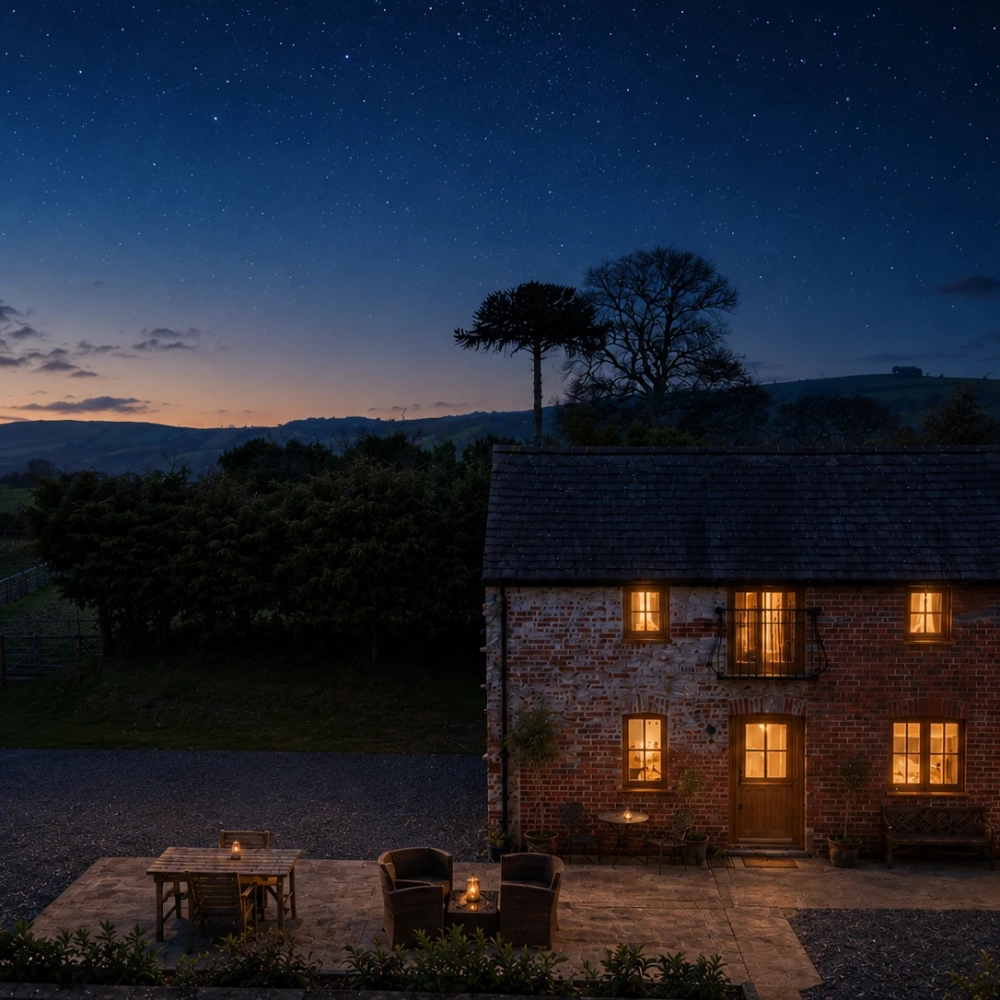
There is something wonderfully humbling about stepping outside after dark, wrapping yourself in a blanket and looking up.
Far from the bright lights of towns and cities, the skies above the Black Mountain can reveal countless stars that often go unnoticed elsewhere. You do not need to know the names of every constellation or own expensive equipment. All you really need is a clear night, a little patience and the curiosity to look upwards.
Whether you are enjoying an evening in Y Golchdy’s hot tub or settling into the garden at Gablebach Cottage, the night sky has a habit of making everything feel a little quieter.
You don’t need to be an astronomer
One of the biggest misconceptions about stargazing is that you need specialist knowledge or an impressive collection of equipment.
In reality, your eyes are often the best place to begin.
After stepping outside, give them at least ten or fifteen minutes to adjust to the darkness. At first, you may notice only the brightest stars. Gradually, more will begin to appear until the sky looks quite different from the one you first saw.
The longer you wait, the more the darkness reveals.
Begin at your cottage
You do not need to travel anywhere to enjoy the night sky during your stay.
Both Black Mountain Escapes properties have private outdoor spaces where you can sit back, switch off the lights and look upwards. At Y Golchdy, you can watch the stars from beneath the veranda or while relaxing in the hot tub. Guests staying there will also find a telescope provided at the cottage for a closer look at the night sky.
At Gablebach, the enclosed garden and outdoor bath house offer an equally lovely place to pause after dark and enjoy the stillness of the countryside.
Some evenings you may spot satellites moving silently overhead. On others, you might see a shooting star, recognise a familiar constellation or glimpse the hazy band of the Milky Way.
Choose your moment
A clear, cloudless night will naturally give you the best chance of seeing plenty of stars. Cold winter evenings are often especially good because the air can be clearer and darkness arrives much earlier, although stargazing can be enjoyed at any time of year.
The moon also makes a difference. A bright full moon can be beautiful in its own right, but its light makes the fainter stars harder to see. For deeper darkness, try looking up before the moon rises or during a part of the month when it appears as a narrower crescent.
There is no wrong choice, though. A moonlit landscape can be every bit as memorable as a sky filled with constellations.
Make yourself comfortable
The best stargazing sessions rarely involve standing around and craning your neck.
Take a blanket outside, find somewhere comfortable to sit or lie back, and wrap up more warmly than you think you will need. Even summer evenings beneath the Black Mountain can become surprisingly cool once the sun has disappeared.
A flask of tea or hot chocolate is always a good idea. A glass of something special works rather nicely too.
There is no need to rush. The stars are not going anywhere.
What to take outside
You need very little to begin stargazing, but a few simple things can make the evening more comfortable:
- Warm layers, even during the summer
- A blanket or something comfortable to sit on
- A torch, preferably with a red-light setting
- A flask of something warm
- A fully charged mobile phone
- Binoculars, if you happen to have them
- A stargazing app to help identify stars and constellations
Try not to look at your phone too often. Even a dim screen can affect your night vision and make it harder to see the fainter stars. Many stargazing apps offer a red-screen mode, which is gentler on eyes that have adjusted to the dark.
If you venture beyond the property
The countryside surrounding the Black Mountain offers wonderfully dark skies, but heading out after dark requires a little more preparation.
Tell someone where you are going, take a fully charged phone and carry a reliable torch. Wear suitable footwear and remain on recognised public routes. Familiar paths and uneven ground can feel very different once daylight has disappeared.
Please remember that the telescope at Y Golchdy belongs to the cottage and should remain at the property. It is there for guests to enjoy safely from the veranda and outdoor areas during their stay.
For an evening away from the cottage, we recommend taking a torch, warm layers, waterproof clothing, a blanket and perhaps a pair of binoculars instead.
A few constellations to look for
You do not need to learn dozens of constellations. Spotting just one familiar pattern can be enough to help the rest of the sky begin to make sense.
The Plough
One of the easiest patterns to recognise, the Plough resembles a saucepan made from seven bright stars. It forms part of the larger constellation Ursa Major, also known as the Great Bear.
Orion
Orion is most easily seen during the winter months. Look for three bright stars arranged in a short, straight line. These form Orion’s Belt, with other stars surrounding them to create the figure of the hunter.
Cassiopeia
Cassiopeia is known for its distinctive five-star shape, which resembles a letter W or M depending on its position in the sky.
Different constellations become visible throughout the year, so do not be disappointed if the one you are searching for is not appearing that evening. The night sky changes with the seasons, giving you something different to discover on every visit.
Be patient with the darkness
After leaving a brightly lit room, your eyes need time to adapt. Resist the urge to check your phone or switch on a powerful torch every few minutes.
Instead, settle into the darkness and notice how your surroundings gradually change. More stars will become visible, the outline of the landscape will sharpen and the sounds of the countryside will begin to stand out.
You may hear an owl calling, animals moving through the undergrowth or the breeze passing through nearby trees. Stargazing is not only about what you can see.
Sometimes, simply looking up is enough
Stargazing does not need to become a list of constellations to identify or planets to find.
Some nights you may spend an hour carefully exploring the sky. On others, you may simply sit beneath the stars, listen to the countryside and enjoy how quiet the world becomes after dark.
Both are time well spent.
Perhaps that is the real pleasure of stargazing. It gives us an excuse to stop, put away our screens and remember that we are standing on a small patch of earth beneath something impossibly vast.
Ready to discover the Black Mountain?
Every stay begins with a slower pace of life.